

In the woodworking industry, mortising, as a traditional and stable joining method, has always held a vital position. The advent of the double-track, five-disc tenoning machine provides strong support for efficient and precise tenoning. Its unique structural design and advanced cutting technology enable it to quickly and accurately create various tenons on wood ends, significantly improving production efficiency and product quality. It is widely used in industries such as furniture manufacturing, door and window production, and handicraft processing.
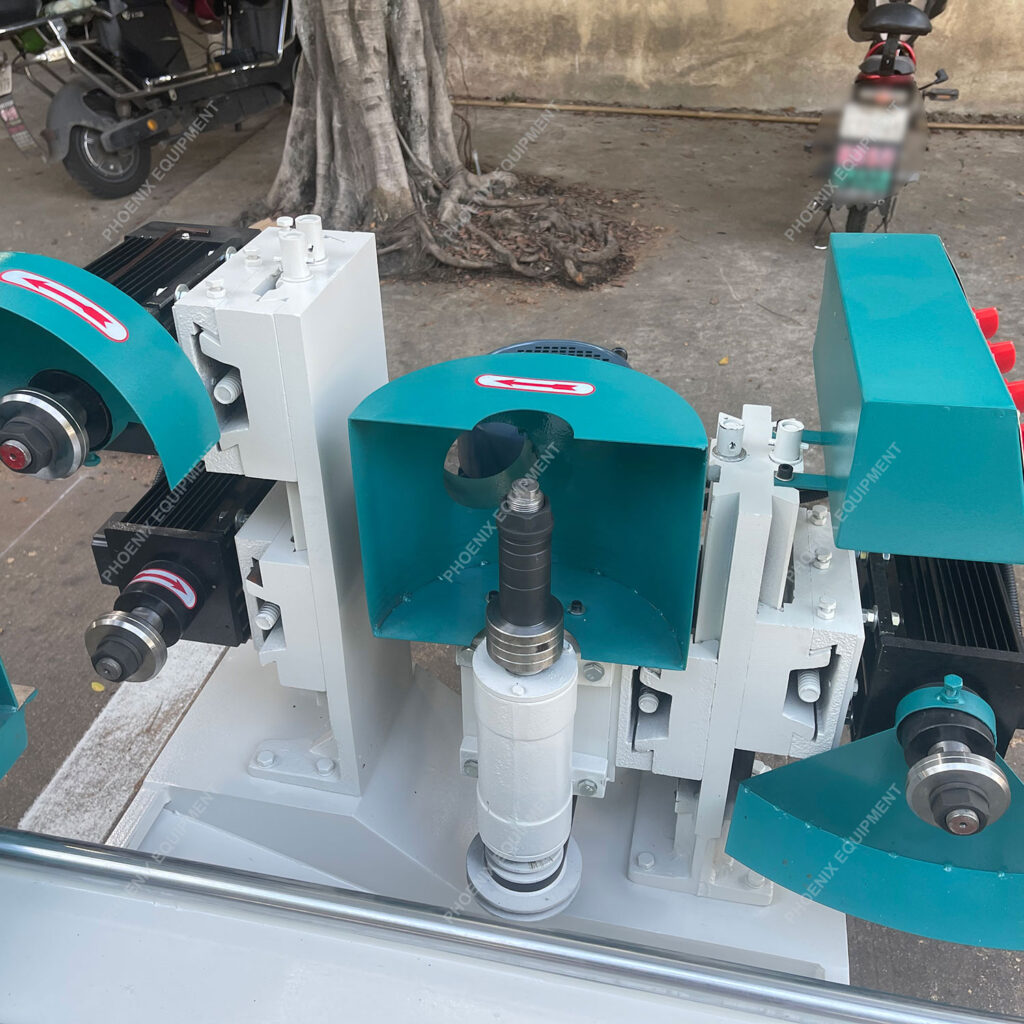
The double-track, five-disc tenoning machine operates on the principle of “precise positioning and efficient cutting.” When the wood is secured to the worktable and moved along the double tracks to the cutting area, the five-disc cutting mechanism begins operation. Five cutting discs sequentially cut the wood ends according to a pre-set sequence and angle. First, the two outer cutting discs remove excess wood corners and define the general shape of the tenon. The three center cutting discs further refine the tenon, milling the tenon shoulder, tongue, or creating a specifically shaped groove. During the cutting process, the cutting disc’s rotational speed and feed rate must be matched to the wood material. For hardwood, the feed rate should be appropriately reduced (generally 1-3 m/min) and the cutting disc’s rotational speed increased (up to 6,000-8,000 rpm) to ensure cutting quality and prevent excessive tool wear. For softwood, the feed rate can be appropriately increased (3-6 m/min) to ensure both precision and improved production efficiency.

From hand-carved tenons to automated processing using a double-track, five-disc tenoning machine, the development of mortise and tenoning technology has witnessed the rapid advancement of wood processing technology. With its efficient and precise processing capabilities, the double-track, five-disc tenoning machine has revitalized wood mortise and tenoning. It not only helps wood processing companies improve production efficiency and product quality, but also plays a vital role in driving the wood processing industry towards intelligent and sophisticated processes, occupying an indispensable position in the modern wood industry.
